
Part 4: "Something A Banker Will Understand"
by Paul Schatzkin
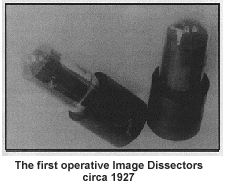
In the fall of 1927, Phlio T. Farnsworth and his friends became the first humans to gaze into
the shimmering eye of electronic television. Who could have guessed then that the rest of the
world would not share the experience for another twenty years?
 For
Farnsworth himself, the moment of triumph quickly passed as he considered the
magnitude of the job that now lay before him. The crude, flickering image proved
that the idea that struck him when he was 13 would work; it also proved that
a great deal more would be required to take this fragile invention from the
laboratory to the living room. For
Farnsworth himself, the moment of triumph quickly passed as he considered the
magnitude of the job that now lay before him. The crude, flickering image proved
that the idea that struck him when he was 13 would work; it also proved that
a great deal more would be required to take this fragile invention from the
laboratory to the living room.
There were occasional callers at 202 Green Street during this period; some of the backers took
a keen interest in the venture and dropped by from time to time to see what, if anything, had
become of this curiosity they'd launched. Invariably, the equipment was disassembled,
strewn across the table top and "temporarily inoperative." The backers had only
George Everson's eyewitness accounts to assure them that Farnsworth had indeed produced
encouraging results.
Work continued for another year, funded for the most part out-of-pocket by the Crocker group.
The group grew steadily, as new investors were enlisted to raise additional capital in order to
meed the escalating monthly expenses. The financing arrangements called on all the original
partners to contribute proportionately in accordance with me size of their holdings. Most of the
backers were experienced investors with enough cash on hand to meet their obligation without
diluting their equity, but Farnsworth was both the largest single stockholder and the least able to
draw on personal cash resources. Consequently, most of the stock that was sold to new investors
was Farnsworth's.
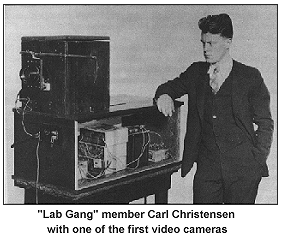
Along with the roster of investors, the work force at 202 Green Street grew steadily as well. All
of the men Phil hired got caught in the pioneering spirit of their work, and shared a special
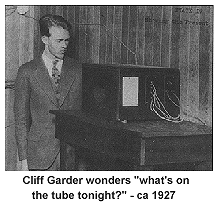
camaraderie. In the next year, Phil and Cliff Gardner and the "lab gang," as they called
themselves, rebuilt the video system dozens of times in a tedious, time consuming process
designed to bring me rudimentary system up to some acceptable standard.
Farnsworth concentrated his attention on increasing the number of scan lines, and set his
sights on a minimum 400 lines per frame. For comparison, the mechanically scanned television
devices everyone else was experimenting with at the time were capable of 50 lines per frame at
best.
Farnsworth continued using geometric shapes like crosses and triangles for his experimental
transmissions. One night while looking at the receiver, Phil unexpectedly saw a moving line that
looked like . . . uh oh . . . smoke. The moment he realized what he was seeing, he thought the
lab was on fire. In the next instant, Cliff's hand waved in front of the camera--holding a
cigarette. Phil sighed gratefully and peered closer at the swirling patterns. He could clearly see
the delicate spirals of vapor; the whole effect was conveyed with startling definition. When
George Everson saw it, he declared it was a sign of real progress.
In the Spring of 1928, Roy Bishop pulled George Into his office and handed him some figures
that showed that more than twice the original limit--nearly $60,000-- had been spent to meet
lab expenses. Confronted with these figures, George agreed with Bishop that it was time
for Farnsworth to show his invention to the people who were paying for it.
Phil was just as surprised as George at Bishop's figures. Still, he was hesitant to make a formal
presentation of his work; the system was still very fragile. Its reliability was tenuous at best.
Besides, he felt that he was on the verge of producing a really fine picture, one that would be
clearer and much more stable. He pleaded with George for just a few more weeks, but George
reminded Phil of the serious tone in Bishop's voice, and a date was set for a demonstration.
The Crocker group reassembled at 202 Green Street in May of 1928, together for the first time
since that unlikely day 16 months earlier when they first met a 19-year-old boy who told them
that he could invent television -- whatever the hell that was. They really understood very little
of what Philo Farnsworth told them that day, but for some unexplainable reason it smelled like a
winner, so they went for it. Now, 16 months later, as they were ushered into the quiet, darkened
lab, they had no idea what to expect. None of them had ever seen television before.
 "This is something a banker will understand," Phil said to George as he switched
on the system. When the little round screen hummed and flickered to life, Fagan
and his friends gazed in hushed bewilderment as an apparition of a dollar sign
($) materialized out of the darkness.
"This is something a banker will understand," Phil said to George as he switched
on the system. When the little round screen hummed and flickered to life, Fagan
and his friends gazed in hushed bewilderment as an apparition of a dollar sign
($) materialized out of the darkness.
Roy Bishop was the first to speak after the demonstration, which included a variety of
geometric shapes and the swirling kinetic patterns of cigarette smoke. Bishop
warmly congratulated Phil for delivering "his end of the bargain" and then set a more sober tone
for the weeks, months and years to ahead: "It will take a pile of money as high as Telegraph Hill
to successfully conclude this work," Bishop declared. Phil listened on anxiously as Bishop
added, "I think we should take immediate steps to sell this invention to one of the large electrical
companies that can afford to provide more adequate capital and facilities."
Bishop's proposal came as no surprise to Phil. He fully expected all along that once he had
proven that his idea would work, the backers would try to sell it quickly, hoping for a handsome
cash return on their original investment. Similar scenarios were common to the stories of many
other inventors, and Phil was determined not to share their fate. He had done all he could to
forestall this moment of reckoning by postponing the demonstration as long as possible. Still,
nothing quite prepared him for the lack of foresight he detected in Roy Bishop's remarks, and for
a moment he was speechless.
When he did apeak, Farnsworth's carefully chosen words concealed his true anxiety; instead,
he outlined what had been brimming through his own mind, his own scenario for the future.
As Farnsworth figured it, he and his men were in the enviable position of having broken
ground in fertile new territory. If they stuck together and followed through on their initial
success, many more patent-worthy improvements would follow. Indeed, it was obvious from
the initial results that there were many problems to be solved. By continuing at their present
pace, the clever men of Farnsworth's Lab Gang would find the problems first, solve them first,
and file patents on those solutions. As they worked out the bugs, they would build a broad patent
portfolio, gradually wrapping a hammerlock of patents around the new art as it marched
inexorably toward a mass commercial market.
In the end, Phil reasoned, everybody who wanted to get into the television business would
have to come to Farnsworth to license his patents Thus, the patents would earn from royalties
many times more than what they could get if they tried to cash out now.
Phil couldn't argue Bishop's premise -- the real work of refinement and engineering was just
beginning and the work would be costly. But this was not a tangle of tubes and wires laying on a
workbench -- this was true television, the ultimate fulfilment of decades of science fiction
fantasies about "pictures that could fly through the air."
Perhaps Farnsworth's youth enabled him to see farther into the future than his backers, who
were many years his senior. Phil believed that the long range return from his invention would
dwarf the initial outlay of capital. It seemed like only a matter of time and perseverance before
the world beat not just a path but a veritable highway to their door.
With some verbal assistance from George, the matter of selling the venture was tabled --
temporarily -- and the Crocker group agreed to continue finding money to support Phil's work.
But there was little time for comfort. Farnsworth realized now that there was a genuine
disparity in the level of his own commitment and the level of commitment he could expect in the
future from his present backers.
 After Bishop and Fagan and their friends left the lab that night, Phil and Cliff
Gardner sat down together for a moment to think about what had happened. As
they talked, Phil contemplated the implications of what Roy Bishop had proposed;
the prospect of selling out left him numb and cold. Phil felt that he was the
only one who could perfect his invention. He didn't want to do it while he was
working for someone else. He wanted to work for himself, be his own boss, set
his own pace and exercise the freedom in me years ahead to follow his own imagination.
After Bishop and Fagan and their friends left the lab that night, Phil and Cliff
Gardner sat down together for a moment to think about what had happened. As
they talked, Phil contemplated the implications of what Roy Bishop had proposed;
the prospect of selling out left him numb and cold. Phil felt that he was the
only one who could perfect his invention. He didn't want to do it while he was
working for someone else. He wanted to work for himself, be his own boss, set
his own pace and exercise the freedom in me years ahead to follow his own imagination.
Thus, the aftermath of the first demonstration for his backers signaled a new phase in Philo
Farnsworth's career: A boy's dream to make an idea work had become the classic struggle of a
young inventor as he tried to continue his pioneering work while also maintaining the very
independence that nourished his original thinking.
End of Part Four
Continue with :
Part 5: A Beautiful Instrument"
This story is brought to you
as a public service by:
| 49chevy.com |
� 1977, 2001Paul Schatzkin; All Rights Reserved
For more information contact: The Perfesser
|