Part 7: Suspended Animation
by Paul Schatzkin
In 1933, after Farnsworth abruptly terminated his arrangement with
Philco and struck off once again on his own, he resumed his efforts
to find another company willing to support his research with a patent
license. Much to his consternation, there were no takers. This seemed
odd, since clearly, Farnsworth's television system was light years ahead
of the competition, most of whom were still experimenting with variations
on the Nipkow Disk systems that were developed in the '20's.
Through contacts in the industry, Farnsworth and his backers learned
why none of the most likely candidates would offer Farnsworth a license
for his patents. All these companies were actively engaged in the manufacture
of radio equipment, and so were dependent on patent licenses with the
Radio Corporation of America for their livelihood. As RCA chief David
Sarnoff liked to say in closed quarters, "The Radio Corporation
does not pay patent royalties, we collect them," and the companies
that Farnsworth was approaching were the very companies that paid RCA
those royalties. And through their sources, Farnsworth's people learned
that RCA had issued another unwritten edict to their licensees: work
with Farnsworth, and their radio patent licenses would be terminated.
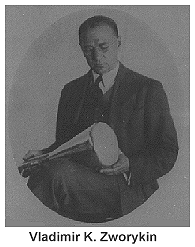 RCA apparently based its position on a deepening relationship with Vladimir
Zworykin and his 1923 patent application. By the early 1933, Zworykin
was demonstrating a camera tube he called the "Iconoscope."
The true origins of the Iconoscope are dubious at best: some essential
components of the device can be traced to the Hungarian inventor Kalman
Tihanyi, and a similar tube, dubbed the "Emitron," emerged
from the laboratories of EMI in Britain -- an RCA cross-licensee --
about the same time Zworykin's Iconoscope first appeared in America.
RCA apparently based its position on a deepening relationship with Vladimir
Zworykin and his 1923 patent application. By the early 1933, Zworykin
was demonstrating a camera tube he called the "Iconoscope."
The true origins of the Iconoscope are dubious at best: some essential
components of the device can be traced to the Hungarian inventor Kalman
Tihanyi, and a similar tube, dubbed the "Emitron," emerged
from the laboratories of EMI in Britain -- an RCA cross-licensee --
about the same time Zworykin's Iconoscope first appeared in America.
Regardless of its questionable origins, the Iconoscope was the device
upon which Sarnoff was determined to extend his empire and go down in
history as the man who gave television to the world. Even though there
was not yet an actual patent for the Iconoscope -- only the still-open
patent application from 1923 -- RCA's attorneys went so far as to assert
behind-the-scenes that the Iconoscope had priority over the Image Dissector,
and that Farnsworth's patents infringed on Zworykin's application. On
the basis of this flimsy claim, RCA threatened behind the scenes to
put any body who did business with Farnsworth out of business.
Realizing the bind they were in, Farnsworth and his backers did the
only thing they could do: they mounted a challenge before the examiners
of the U.S. Patent Office.
Accepting Farnsworth's challenge made perfect sense from Sarnoff's
point of view: Not only did RCA have a perfect record of defeating lesser
adversaries in patent litigation, but the company was spending money
on television at TEN TIMES the rate that Farnsworth was spending. Sarnoff
needed a quick retum on all that investment in order to preserve his
reputation and calm the rumblings on his board of directors. Surely
, the fledgling Farnsworth organization seemed like yet another easy
target for the formidable legal forces of "the Radio Corporation."
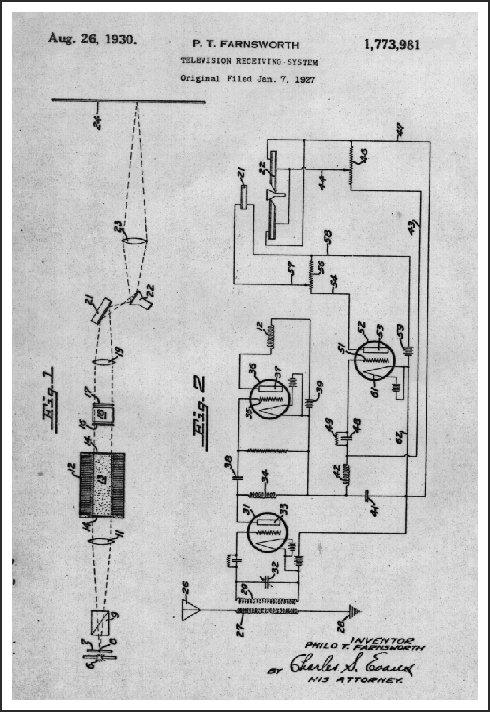
The ensuing interference proceedings focused primarily on Claim 15
of Farnsworth's 1930 patent #1,773,980,
which describes the simple, elegant concept of an "electrical image,"
which is the critical step in the process of converting light into electricity.
There is something slightly intangible embodied in the precise wording
of Claim 15 which reveals the indispensable process of creating an electrical
counterpart of an optical image, in which values of electricity correspond
to values of light. Claim 15 calls it:
An apparatus for television which comprises means for forming
an electrical image, and means for scanning each elementary area of
the electrical image, and means for producing a train of electrical
energy in accordance with the intensity of the elementary area of the
electrical image being scanned.
This paragraph, first composed in 1927, announces the arrival of television
on this planet, and is essentially the idea that 13-year-old Philo T.
Farnsworth pictured in his mind's eye that hot afternoon five years
earlier while he tilled the potato fields in Rigby Idaho. This paragraph
describes the essence of Farnsworth's invention, the missing ingredient,
which, once found, paved the way for television as we now know it. Yet
in 1934, RCA's attorneys tried to prove that Zworykin had the idea first.
Farnsworth spent many weeks answering an endless inundation of questions
posed by a battery of RCA's biggest legal guns. Literally reams of testimony
were taken. Every stack of depositions meant another week that Farnsworth
was kept out of his laboratory, another week of progress lost to the
competition.
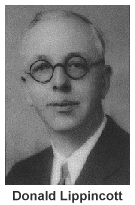 The champion of Farnsworth's case was a sharp young attorney, Donald
K. Lippincott, who was every bit as much an engineer as he was a lawyer.
Lippincott held Phil and his abilities in great esteem; For his part,
Phil regarded Don as "urbane without being Eastern." Together
the two saw right through RCA's semantic charades and chipped away at
RCA's case. They built clear concise and uncompromising arguments that
methodically demolished RCA's claim.
The champion of Farnsworth's case was a sharp young attorney, Donald
K. Lippincott, who was every bit as much an engineer as he was a lawyer.
Lippincott held Phil and his abilities in great esteem; For his part,
Phil regarded Don as "urbane without being Eastern." Together
the two saw right through RCA's semantic charades and chipped away at
RCA's case. They built clear concise and uncompromising arguments that
methodically demolished RCA's claim.
Farnsworth and Lippincott delivered a dramatic tour-de-force when
RCA challenged Phil's claim that he had first thought of his approach
to electronic television while he was a high school freshman in Rigby,
Idaho. RCA's attorneys greeted this assertion with a laugh - how could
a mere child possibly dream up something as intricate as electronic
television? Certain that Farnsworth couldn't possibly support this bold
contention, the opposition pressed the point.
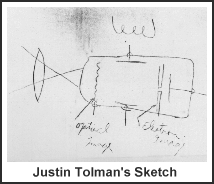
RCA's disbelief started to crumble when Lippincott and one RCA attorney
went to Salt Lake City and tracked down Justin Tolman. Tolman recalled
clearly the day that his young student drew a series of diagrams on
the blackboard in Rigby. Then to the amazement of both Lippincott and
the RCA lawyer, Tolman drew from memory a simple sketch of an electronic
tube, which turned out to be a precise replica of an Image Dissector.
The RCA attorney shook his head in silence as he handed the drawing
back to Lippincott.
 Despite the gravity of the case at hand, RCA's case was surprisingly
weak. There was no effort to produce into evidence a tube from 1923
that would substantiate Zworykin's claim to have had an operable television
transmitter at that time. There were some vague verbal accounts, and
those were dismissed by the examiners as unreliable, having been "influenced
by later events and knowledge." In other words, when it mattered
most, RCA was either unwilling or unable to produce the evidence that
would today support Zworykin's claim to have invented the Iconoscope
-- or something like it -- in 1923.
Despite the gravity of the case at hand, RCA's case was surprisingly
weak. There was no effort to produce into evidence a tube from 1923
that would substantiate Zworykin's claim to have had an operable television
transmitter at that time. There were some vague verbal accounts, and
those were dismissed by the examiners as unreliable, having been "influenced
by later events and knowledge." In other words, when it mattered
most, RCA was either unwilling or unable to produce the evidence that
would today support Zworykin's claim to have invented the Iconoscope
-- or something like it -- in 1923.
In April of 1934, the United States Patent Office delivered its first
milestone decision in the case of Zworykin vs. Farnsworth. In its final
ruling in case #64, 027, the patent examiners summarily dismissed RCA's
claim in terms that spoke almost derisively of RCA's entire presentation,
saying in conclusion:
1. That Zworykin has no right to make the count by virtue
of the specific definition of the term "electrical image"
given in the Farnsworth patent;
2. Zworykin has no right to make the count because it is not apparent
that the device would operate to produce a scanned electrical image
unless it has discrete globules capable of producing discrete space
charges and the Zworykin application as filed does not disclose such
a device {note: this clause basically states that the device disclosed
in 1923 could NOT have been an Iconoscope... but we'll come back to
that later...}
3. That Zworykin has no right to make the count even if the device
originally disclosed operates in the manner now alleged by Zworykin
because this alleged mode of operation does not produce an electrical
image that is scanned to produce the television signals.
After a few more pages of legal discourse, the decision ends with
an unequivocal declaration:
"Priority of invention is awarded Philo T. Farnsworth."
Unfortunately, this resounding proclamation was followed by one more
little sentence: "Limit of Appeal: August 22, 1935. In other words,
RCA had sixteen months to appeal the decision. With no money left to
carry on the fight if RCA did appeal, Farnsworth and his backers waited,
holding their breath everyday of those sixteen months. On the last possible
day, RCA filed their appeal. This appeal was eventually denied, but
the die was now cast: Farnsworth's entanglements with RCA went on for
years, and placed the future of television in a state of suspended animation.
Things took a brighter turn in the summer of 1934, when the prestigious
Franklin Institute of Philadelphia invited Philo T. Farnsworth to
conduct the world's first full scale public demonstration of television.
Encouraged as he was by the steadily improving performance of the
Image Dissector, Farnsworth accepted the invitation, and disregarded
for the time being his stalemate with RCA. After all, the future of
television belonged not with any single corporation, but with the people,
the audience that would buy television sets and watch television programs.
Farnsworth hoped to score some points with the public by being the first
to show them what they could expect.
While Farnsworth was preparing for the Franklin Institute exhibit,
he was introduced to Russell Seymour Turner, known to his friends as
"Skee." Turner was an engineer and businessman whose wealthy
father had acquired a healthy chunk of the Farnsworth stock that George
Everson and Jess McCargar continued to sell to raise funds for the ongoing
research. Skee was sent in to see what he could do to push the enterprise
closer to some sort of pay off. Skee was smitten immediately with the
Farnsworth charm, and began to take a strong personal interest in Phil
and the things that he had to offer.
Turner saw to it that Farnsworth had enough funds to build a completely
new system for the Franklin Institute exhibit. The picture tube that
Cliff made was the size of a ten gallon jug and the camera was compact
even by today's standards. So equipped, Farnsworth was handsomely prepared
to introduce his invention.
The exhibit was an unprecedented success. There was little advanced
publicity - only word-of-mouth -but people were lined up for blocks
when the doors opened in August, 1934. The response was so strong that
the event, which was originally scheduled to last ten days, went on
day and night for three weeks.
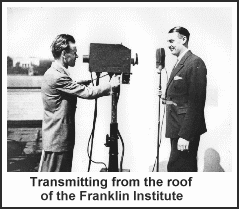 Farnsworth placed one camera unit near the door, and the power of his
invention was instantly driven home to anyone who entered, as they were
immediately confronted by their own disembodied image flickering across
the bottom of a ten gallon bottle.
Farnsworth placed one camera unit near the door, and the power of his
invention was instantly driven home to anyone who entered, as they were
immediately confronted by their own disembodied image flickering across
the bottom of a ten gallon bottle.
Programs were thrown together spontaneously and transmitted from the
roof to an auditorium downstairs. Thousands of Philadelphians poured
through the auditorium in 15 minute intervals to see what ever was appearing.
Vaudeville acts, popular athletes and a swarm of politicians volunteered
to appear before Farnsworth's cameras.
The crowds were totally ambivalent to the content. They came to see
the image on the screen, whatever it was. They came to witness the ancient
dream of seeing at a distance. For the Depression-weary populace, this
was something really new - something that spoke of a future, an oracle
of better times to come.
Their success at the Franklin Institute was a terrific morale booster
for Farnsworth and his men. It was their first contact with so large
an audience, their first undeniable proof of how big television was
going to be.
The Franklin Institute demonstration attracted considerable international
attention, and marked the beginning of a steady flow of foreign visitors
to Farnsworth's lab at 127 Mermaid Lane in the Philadelphia suburbs.
Scientists and dignitaries from all over the world came to see the miracle
in Farnsworth's living room. Phil and Skee Turner learned a great deal
from their guests about the state of television around the world. They
were particularly interested in stories about England, where the BBC
had been conducting experimental video broadcasts for some years.
The system that the BBC was using was a mechanically scanned device
that was invented by a Scotsman named John Logie Baird. Baird's first
successful visual transmissions occurred in 1926, when he sent some
semblance of the head of a dummy from one room to another. Some years
later Baird convinced a reluctant BBC to permit him to use their channels
in the evenings to broadcast blurry programs to a handful of receivers.
By 1934, Baird had sold more than 20,000 "Televisor" receivers
in kit-form all over Europe. Still, the BBC was disappointed in the
quality of Baird's picture and started looking for something better.
In the early Thirties, Baird's fortunes fell into the hands of a large
British holding company called British Gaumont. Feeling that they had
a considerable investment to protect, British Gaumont pushed Baird to
abandon his mechanically scanned Televisor in favor of electronically
scanned video. British Gaumont reasoned that if the BBC wanted electronic
video, then Baird should be the one to provide them with it, even if
that meant taking a license with another inventor.
As providence would have it, Baird's people learned of a young inventor
in America who was offering just such a license, and quickly dispatched
a group of engineers to Philadelphia to see what the boy had to offer.
Philo Farnsworth and Skee Turner received the news of a possible license
from Baird with tremendous excitement - a license in England could be
the prelude to a whole series of licenses all over Europe. On arrival
in Philadelphia, the English engineers were instantly impressed with
Farnsworth's system, and at their invitation arrangements were made
to take Farnsworth and his invention to England, where negotiations
would be concluded.
Phil and Skee reveled in the unexpected change of fortunes. At last
it seemed there was new hope for television. So Philo T. Farnsworth
carefully crated up his circa 1934 television "mobile unit"
and sailed for Southampton, hoping to accomplish in Europe what he could
not accomplish in America.
End of Part Seven
Continue with:
Part 8: "We Want CASH!"
This story is brought to you
as a public service by:
| 49chevy.com |
� 1977, 2001Paul Schatzkin; All Rights Reserved
For more information contact: The Perfesser
|